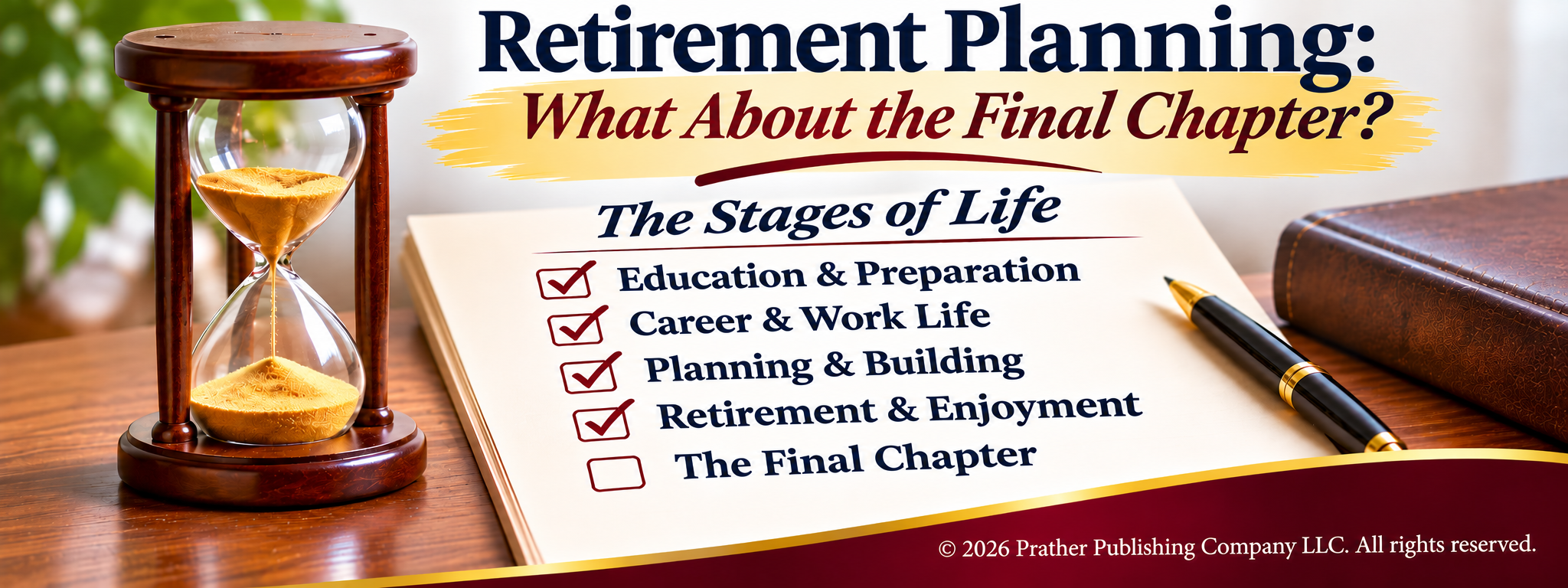
Retirement Planning: What About the Final Chapter?
We plan for retirement. But how much thought do we give to what comes afterward?
For many people, retirement represents the reward for decades of hard work. We think about Social Security, pensions, retirement savings, healthcare, travel, and enjoying time with family.
We spend years preparing financially for retirement. We want to know whether we have enough money, how long our savings will last, and whether we can maintain our lifestyle.
But there is another part of retirement planning that often receives very little attention.
What happens when retirement comes to an end?
The Conversation We Tend to Avoid
Most people understand that someday their family or loved ones will have to deal with the responsibilities left behind.
Yet, knowing something needs to be done and actually doing it are two different things.
Some people simply don't want to think about it. Others intend to get around to it eventually. And many begin considering what needs to be done, only to become overwhelmed by the number of decisions involved.
The result? Nothing gets done.
Paralysis From Analysis
There is an old expression: paralysis from analysis.
It describes what happens when we become so consumed with thinking about a problem that we never take action.
End-of-life planning can create exactly that situation.
Where do I begin? What decisions should I make? How much time will this take? Do I need an attorney? What about my financial affairs? What will my family need to know?
Before long, what started as a good intention becomes another project for another day.
And another day can turn into another year.
Leaving It for Someone Else to Figure Out
There is another reality we don't always acknowledge.
Sometimes, whether intentionally or not, we leave the responsibility to those who survive us.
After all, we won't be here to deal with it.
But someone will.
That someone may be a spouse, an adult child, another family member, or a trusted individual who suddenly finds themselves responsible for making decisions during an already difficult time.
The question is not whether someone will have to address these matters.
The question is how much uncertainty we want to leave behind.
Planning Doesn't Have to Become Another Full-Time Job
Perhaps one reason people avoid end-of-life planning is that they believe everything must be accomplished at once.
It doesn't.
Planning can begin with a conversation, a few decisions, or simply understanding what responsibilities someone else may eventually face.
You don't need to solve every problem today.
You just need to begin.
Retirement Planning Should Include the Final Chapter
Retirement planning is about more than accumulating enough money to stop working.
It is about preparing for the years ahead, including the responsibilities that eventually pass to others.
We cannot eliminate every difficulty our loved ones may face. But we can make some of those responsibilities easier to manage.
And perhaps that is one of the most meaningful things we can do for them.
The final chapter of retirement deserves some planning, too.
A Resource to Help You Begin
My book, EOL (End of Life), addresses a subject many people recognize as important but would rather postpone.
The goal is not to make planning more complicated. It is to encourage readers to begin thinking about the decisions and responsibilities that should not be left entirely to others.
You have spent years preparing for retirement. Have you given any thought to its final chapter?
Learn more about EOL on Amazon.
© 2026 Prather Publishing Company LLC. All rights reserved.